Bennett Salvatore prevented the Mavs being in a commanding position - from which they would've enjoyed strong odds of winning the NBA Championship. It's nauseating to reflect that NBA referees never want to "decide the game" on a last second shot, and that their code is to blow a last second whistle only if the offensive player draws very obvious and obstructive contact.
I doubt very many, if any, NBA officials have it out for Mark Cuban. I've faith in their professionalism. That said, if any referee has it out for Cuban, Bennett Salvatore is a good candidate to be that ref. Salvatore is old school - old old ooooollllldddd school - East Coast, old country, Italian. EVERYTHING about Mark Cuban could easily stick in Bennett Salvatore's craw. Salvatore is a good candidate to have said to himself:
"If I see any sliver of justifiable contact here, I'm making the call. F___ Mark Cuban. It's payback time."
Did Salvatore do that? I've not one single clue, and it's useless to dwell on it. But it is kind of fun to notice it.
All that said, the Mavericks beat themselves, through sloppy offense and defense down the stretch - as well as through Dirk and Josh Howard missing 3 free throws. Bitching about an NBA call is exactly like a batter who bitches about getting bad calls on third strikes: the batter should hit the ball before two strikes are on him. Otherwise, he's setting himself up for bad things to happen. The Mavs set themselves up for bad things to happen. It was the Mavs' own fault they lost the game. They should've had a points cushion at the end.
In Dallas, they are showing the last play over and over on TV. Wade said he got hit twice on the play. He didn't get hit. Here's what actually happened:
1. In a very close play, Wade arguably touched the inbounds pass in the frontcourt, before moving into the backcourt. Personally, I say the tie goes to the catcher. I would not have called a backcourt violation.
2. Wade dribbles right. When Terry attempts to cut him off on the sideline, Wade administers a forearm shiver. Terry trips and goes down, flying out of bounds. As an NBA referee, I would've let this last-second, jostling contact go w/o a call - mostly b/c Terry partially slip/tripped. It's a close judgment, though. Wade's forearm did contribute to Terry's slip/trip, and did free him of Terry's defense, and did give Wade a competitive advantage.
3. Now, with Terry out of bounds, and laying beside the press table, Wade heads up the sideline, towards the baseline. He is doubled by Howard - closest to the baseline, and by Harris - closest to midcourt. At this moment, as Wade advances towards the corner, he is dead. He is pinned by two quick guys. He has zero chance of going around either of Howard or Harris; and can only evade through a risky attempt to dribble/split between them. Howard and Harris both have aggressive hands. Both will go for Wade's dribble if he tries to split them. If Wade attempts a corner jumper, he will be heavily pressed from the front by Howard. Harris will be coming from his side, and will be swiping at his shot from over the top. Wade is just about dead. The Mavericks are about to win.
In response - in cheating, yet brilliant response - Wade reprises Michael Jordan's championship shove against Byron what's-his-name of the old Utah Jazz - only, instead of shoving Howard, Wade grabs a gigantic fistful of Howard's shorts, and mightily slings Howard - by Howard's own shorts - towards the baseline. It was a mighty sling - but it was fast and smooth. If I was a referee, I likely would've missed it. However, it was definitely a foul, and it extricated Wade from a very difficult spot. If a ref had seen it, it deserved, w/o a doubt, to be called. In a perfectly refereed game, Howard would've been shooting free throws at the other end, with about 4 seconds on the clock.
The shove moved Howard towards the baseline a bit. What the shove really did was enable Wade to perform a world-class change of direction - as if he had been running down the street, then used a telephone pole to shove himself back in the direction he just came from. The change of direction was so severe that Wade actually passed around the mid-court side of Devin Harris - something which would've been impossible - absent using Howard as a human telephone pole. This is how Harris happened to have his left hand on Wade's right hip as Wade drove to the basket. As Wade went around him on his mid-court side, Harris spun clockwise about 250 degrees.
You saw the rest. Nowitski did an excellent job avoiding the foul, yet distracting Wade with hand and arm movements. On his own, Wade lost control of the ball as he passed Nowitski. Wade desperately fought to control the ball, and to shove it up towards the basket. Nowitski's hand and arm movements attracted Bennett Salvatore's attention. The Mavericks had the rebound in hand.
Salvatore's whistle came from directly behind Wade. Salvatore was positioned behind the play: towards midcourt, and towards press row. When the play began, Salvatore had the best angle on the inbounds pass which could've been called for a backcourt violation, yet made no call. Salvatore was nearest to Wade's forearm shove of Terry, when Terry slip-tripped under the scorer's table, yet made no call. Salvatore, positioned near press row, and looking directly down the sideline towards the baseline, had the best angle on Wade's grab and sling of Howard, yet made no call. Salvatore had absolutely no angle to call Nowitski for a foul. Salvatore was 25 feet behind Wade, and looking directly at Wade's back. Nowitski's arm slashed vertically in front of Wade, without touching him. From behind Wade's back, blind to whether Nowitski's vertically slashing arm touched the front of Wade, Salvatore made the call. Hmmm.
Well, it WAS a heck of an exciting play. World-class athletes on display. As a Mavericks' fan, I know how Utah Jazz fans felt when Michael Jordan committed an offensive foul on his game-winning shot. Byron what's-his-name should've been shooting free throws on the other end. The Jazz were ripped off.
My only consolation is that the loss was the Maverick's own fault. They should've had a points cushion at that juncture.
Monday, June 19, 2006


Friday, April 07, 2006
The 5 Year War Between the White House and the State Department
I've written before about this war, and about how the State Dept. makes constant, ongoing effort to undermine White House goals in the WOT; and about how the White House must fight the State Dept. to get White House directives carried out - even though the State Dept. is part of the Executive Branch, and is subordinate to the White House.
There was an interesting subtext to Samuel Alito's Supreme Court hearing in the Senate Judiciary Committee, when Senate Democrats, again and again, referenced Alito's belief in a "unitary Executive." This was referenced a dozen times - each time in an ominous tone of voice - before I finally went to the Internet to figure out what the gosh they were talking about. A "unitary Executive" means the President manages and directs the Dept's - such as State and the CIA - which are part of the Executive Branch.
It turns out many have argued, in recent years, that Dept.'s which were created to be part of the Executive should have autonomous power, and should not be subject to Presidential management and direction. The argument is that there can be Congressional oversight; and Presidential appointment and firing of Department directors; but the Department Directors ought not be managed or directed by the President. The importance is that Dept. goals and direction would not be set by the President. Democratic Senators, whose party has lost 7 of 10 Presidential elections, seem keen on the idea that the President has not had power to manage and direct Executive Branch Departments in years - and a President would have to be a power hungry madman to try to manage Executive dept's. Alito's argument (and Bush's - presumably) is that Executive Branch Dept's were expressly created for the President to manage, and whatever customs may or may not have been followed in recent years, those alleged customs do not invalidate the President's proper Constitutional authority.
The State Dept., an especially bloated and ineffective bureaucracy, which is filled with virtually unfire-able government workers, is known to be an especially left-wing enclave. There was a funny flap last year, in which State Dept. high-ups leaked their outrage that Bush and Cheney were deciding upon Iraq policies without the input of the State Dept! The outrage was not that Bush and Cheney were ignoring relevant information, but rather that Bush and Cheney had too much power! Bush and Cheney were out of control! Bush and Cheney should be listening to their careerist betters in the State Dept., and thence should follow the advice of their careerist betters (or be subjected to anonymous leak warfare in WaPo and NYT). I exaggerate not, and I kid you not. Bush and Cheney cut out the opportunities for State to wage leak warfare by exorcising State hoity-toities from the decision process. Anonymous State leakers, and the NYT, threw hissy fits.
All of which is prelude to my recommendation of this post, which includes an email from a politically conservative State employee, about doings in Baghdad's Green Zone. Read it all - it's not long. I will excerpt this part:
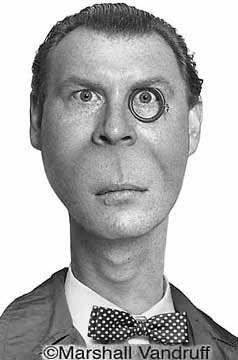
The PRT effort, in short, is State's effort attempt to be as good as Col. McMaster's cavalry regiment in Tal Afar. DoD has 150,000 soldiers out mingling with Iraqis every day on every street corner in Iraq. The State department, on the other hand, has 2000 employees entombed behind the green zone walls, talking to each other inside one of Saddam's former palaces. When they do talk to Iraqis, it is only the governing elite. There isn't a problem with DoD "guarding" the PRTs. The PRTs would be fully integrated with military units (or vice versa). [...]The feeling among too many State career folks is that integrating the military into these PRTs, and working on civil-military matters together with DoD, is allowing "them" into too much of "our turf." It's a turf war, which the department is more adept at fighting than a real one. Nobody will say it, but too many around here see themselves sophisticates, who don't mingle with DoD troglodytes. It's shameful. Naturally, some in the department feel that it is "not their job to talk to the masses." I actually heard someone say that yesterday. Rather, they see their position as more of a 19th century man of leisure, dining with privileged elites. I actually saw a guy last week wearing a monocle. I know it has nothing to do with any of this, but it's a funny anecdote, and funny anecdotes are all that keep from from going insane sometimes. The Secretary [Condi] is fighting a lonely battle. President Bush's State Department staff is about 30 people in total by my count. All the rest are Hillary Clinton's transition team.
Tuesday, April 04, 2006
Everything I Know About Batting
`

Ernie Banks. In Tuscon? Late 1960s? Banks' swing was effortless, perfectly balanced, and generated power.
Ernie Banks grew up in Dallas, TX.
I was fortunate to receive good instruction as a young player. Here are some of the best instructions I received:
Watch the ball meet the bat.
Hit the ball in front.
Think of hitting a pitch with a hammer in your bottom hand: you would not make contact with the hammer beside your belly button, but rather with the hammer beside your front hip. Contact with the baseball should be made right at your front hip. The angle of the bat should be square to the hip, and the bat head square to the ball [as a hammer would be square to a nail].
Swing level
This is more of a mental suggestion for swings in the upper part of the strike zone. It prevents chopping at pitches which are too high; it prevents a loopy swing.
Southern Brother and I fight it out over this instruction near the bottom of this post. He prefers: "keep your hands above the ball". I think that is an unnecessarily complicated instruction for a young child. He argues he has successfully taught it to numerous young children.
When you step in, make sure your bat can touch the outside edge of the plate.
You'll never, ever be a hitter if you swing at high pitches.
Let's talk about this one. It is the truest thing ever. Many hitters never reached their potential b/c they never stopped swinging at high pitches. Here's the cure for swinging at high pitches: swing level when swinging at the top of the strike zone. If you are swinging level, you cannot get your hands high enough to swing at a fantastically high pitch.
Teach your child to swing level at the top of a typical umpire's strike zone - then teach them to never, ever, under penalty of death, swing at anything above that. Not in batting practice. Not in softball or wiffle ball games. And I mean anything. If your child goes to a birthday party, they may not swing at the Pinata! Buy them a Pinata to hit at home, and hang it knee high! :-)

Ernie Banks. In Tuscon? Late 1960s? Banks' swing was effortless, perfectly balanced, and generated power.
Ernie Banks grew up in Dallas, TX.
I was fortunate to receive good instruction as a young player. Here are some of the best instructions I received:
Watch the ball meet the bat.
Hit the ball in front.
Think of hitting a pitch with a hammer in your bottom hand: you would not make contact with the hammer beside your belly button, but rather with the hammer beside your front hip. Contact with the baseball should be made right at your front hip. The angle of the bat should be square to the hip, and the bat head square to the ball [as a hammer would be square to a nail].
Swing level
This is more of a mental suggestion for swings in the upper part of the strike zone. It prevents chopping at pitches which are too high; it prevents a loopy swing.
Southern Brother and I fight it out over this instruction near the bottom of this post. He prefers: "keep your hands above the ball". I think that is an unnecessarily complicated instruction for a young child. He argues he has successfully taught it to numerous young children.
When you step in, make sure your bat can touch the outside edge of the plate.
You'll never, ever be a hitter if you swing at high pitches.
Let's talk about this one. It is the truest thing ever. Many hitters never reached their potential b/c they never stopped swinging at high pitches. Here's the cure for swinging at high pitches: swing level when swinging at the top of the strike zone. If you are swinging level, you cannot get your hands high enough to swing at a fantastically high pitch.
Teach your child to swing level at the top of a typical umpire's strike zone - then teach them to never, ever, under penalty of death, swing at anything above that. Not in batting practice. Not in softball or wiffle ball games. And I mean anything. If your child goes to a birthday party, they may not swing at the Pinata! Buy them a Pinata to hit at home, and hang it knee high! :-)
More good advice, acquired from various places:
Think with your eyes.
I heard this from Texas Rangers coach Rudy Jaramillo. I like this one. Older children need to understand how to approach an at bat. We forget how little they know. You can think between pitches, when you glance at the base coach for a signal. Form your plan for the next pitch, then take a deep breath to 1) relax yourself, and 2) turn your brain off, then step back in. Now think with your eyes. Just react.
You'd think even the smallest child would understand taking a deep breath to relax - but they do not - unless they are instructed.
Think with your eyes.
I heard this from Texas Rangers coach Rudy Jaramillo. I like this one. Older children need to understand how to approach an at bat. We forget how little they know. You can think between pitches, when you glance at the base coach for a signal. Form your plan for the next pitch, then take a deep breath to 1) relax yourself, and 2) turn your brain off, then step back in. Now think with your eyes. Just react.
You'd think even the smallest child would understand taking a deep breath to relax - but they do not - unless they are instructed.
I came up with this next myself, for kids who tense up and swing hard(though it also works for kids who swing wimpy):
Swing loosey-goosey, but hit it with authority.
Ernie Banks is giving a perfect demonstration at top. This is my attempt at Harvey Pennick-type perfect verbiage. Tense kids also need to be taught to hold the bat lightly, as if they were holding a bird. I dislike the instruction: "Hit the ball hard", b/c kids do not understand the physics of bat-head speed, which are somewhat related to the physics of cracking a whip. The child reasons that they must tense up, and give hard effort, in order to hit the ball hard.
Speaking of Harvey Pennick: Look for a pitch in your sweet spot.
Alternate instruction: Look for your pitch. This is the equivalent of Pennick's famous "Take dead aim," b/c it takes a player's mind off of thinking and onto his task. It forces a player to visualize a pitch coming into his sweet spot. The visualization is the key. Everyone from Jack Nicklaus, to The Inner Game of Tennis, to Bob Rotella, talks about visualization. It is a very, very big deal in hitting.
Also, kids don't watch much baseball anymore. They need to be encouraged to develop a loose pre-swing waggle. Kids typically haven't thought of such a thing. They will stand in their stances like brittle statues - unless they are instructed.
Stand in the back of the box, to get a longer look at the pitch.
I would come into at bats looking to see a low fastball really clearly. If I was seeing good, I might hit the first pitch. Sometimes I was seeing bad, and I would watch hittable fastballs go by - even maybe for strike two - because I just wasn't seeing them as well as I wanted to.
With two strikes, I changed approach. I learned to visualize sort of a rectangular hockey net behind me, in the position of a strike zone. I learned to wait and wait and wait on the ball, before committing to it, and to only hit it if it was about to go into my imagined hockey net. In my mind, I was defending the hockey net - like a goalie. I would imagine each two-strike pitch was going to break, and I would wait for the break before I committed to the pitch. This meant, with two strikes, I was never perceiving a fastball which turned out to be a breaking pitch. If the pitch actually was a fastball, I was still able to flick my wrists and get sweet spot on the ball. Obviously, I was not a power hitter! However, I was often surprised at how far I could hit two strike pitches with what felt - to me - like a minimalist wrist flick, and with minimal associated body movement.
Here are things which especially helped me learn to hit breaking pitches:
1) Competitive wiffle ball, with my brother throwing for blood.
2) Competitive ping pong ball baseball. This was played indoors. We hit by holding a wooden Texas Rangers' mini souvenir bat with one hand. The pitcher threw every type of breaking ball he could invent. If you could hit that wildly breaking ping pong ball with one hand on a souvenir bat, you could hit the toughest breaking ball any baseball pitcher could throw at you.
3) One day I took a jugs machine up the hill, and hit about 100 curve balls. By the end of that day, I had tremendous confidence.
A story about my son:
He could hit curves pretty well - until he faced a left hander's curve in 9th grade. He declared he had never faced a left hander's curve. A hunch: I don't think it occurred to Jake that he could hit the pitch anyway. I think he believed if he hadn't hit it in practice, he couldn't hit it in a game. Jake struck out both times he faced those curve balls. The moral, I guess, is to throw left handed curves to your kid with a wiffle ball, or a Jugs machine, or a left-handed friend - just so they get the thought in their head that they can hit the pitch.
And that's about everything I know about batting - except for a bunch of technical stuff which is partly self-taught, and partly mangled second-hand gossip, and may not even be correct! So it's best to stay away from that!
~~~~~~~~~~~~~~~~~~~~~~~~~~~~~~~~~~~~
Update: Big thanks to Southern Brother for writing in with some excellent technical advice for advanced hitters. Since Southern Brother is a college baseball coach, his technical advice is cutting edge! I've always wanted this blog to be cutting edge!
Southern Brother:
Greg's note:
Southern Brother expects an advanced player to quickly process this and then to never give it another thought.
For young players, I don't like "keep your hands above the ball". What young player can understand this? Confusing. Further, I suspect the instruction tends to focus a child's attention on his hand position - and no one wants that. Southern Brother doesn't want that. A child's focus ought be: put sweet spot on the ball. On pitches at the top of the zone, I prefer "swing level". It's simpler, and there's a subtle mental distinction in favor of focusing on putting sweet spot on the ball.
Update: Southern Brother writes in and stands up for "keep your hands above the ball". He argues he has successfully taught it 9 and 10 year olds.
Also, he recounts a funny exchange with his own son over watching the spin of the seams of the ball:
Back to Southern Brother:
Ernie Banks is giving a perfect demonstration at top. This is my attempt at Harvey Pennick-type perfect verbiage. Tense kids also need to be taught to hold the bat lightly, as if they were holding a bird. I dislike the instruction: "Hit the ball hard", b/c kids do not understand the physics of bat-head speed, which are somewhat related to the physics of cracking a whip. The child reasons that they must tense up, and give hard effort, in order to hit the ball hard.
Speaking of Harvey Pennick: Look for a pitch in your sweet spot.
Alternate instruction: Look for your pitch. This is the equivalent of Pennick's famous "Take dead aim," b/c it takes a player's mind off of thinking and onto his task. It forces a player to visualize a pitch coming into his sweet spot. The visualization is the key. Everyone from Jack Nicklaus, to The Inner Game of Tennis, to Bob Rotella, talks about visualization. It is a very, very big deal in hitting.
Also, kids don't watch much baseball anymore. They need to be encouraged to develop a loose pre-swing waggle. Kids typically haven't thought of such a thing. They will stand in their stances like brittle statues - unless they are instructed.
Stand in the back of the box, to get a longer look at the pitch.
I like this, for young players, for unusual reasons:
1) young players can see the plate better when it is out in front of them. Therefore, they develop a better idea of the strike zone. Think about it. If you are an inexperienced player, and the plate is always beside you, it is out of your vision, and you are just guessing about where it is. Your developing concept of the strike zone is stunted.
2) because young players have been instructed to hit the ball in front: when they hit from the back of the box, it especially reinforces this fundamental.
Walk up to the plate (to stay composed and relaxed).
If you strike out, jog back to the dugout.
1) young players can see the plate better when it is out in front of them. Therefore, they develop a better idea of the strike zone. Think about it. If you are an inexperienced player, and the plate is always beside you, it is out of your vision, and you are just guessing about where it is. Your developing concept of the strike zone is stunted.
2) because young players have been instructed to hit the ball in front: when they hit from the back of the box, it especially reinforces this fundamental.
Walk up to the plate (to stay composed and relaxed).
If you strike out, jog back to the dugout.
The walk back, after a strike out, is a moment ripe for mischievous acting-out. Shorten that moment. Decrease acting out. Have the player jog back.
When you have two strikes, you're not looking to hit a strike - you're looking to hit anything the umpire might call a strike.
When you have two strikes, you're not looking to hit a strike - you're looking to hit anything the umpire might call a strike.
If he called it a strike, you should've hit it. Whether it was a strike is irrelevant. If the unfairness of a bad call bothers you, don't let the count go to two strikes.
When I was about 11, my Mom became frustrated with my letting good pitches go by. She began to encourage me to stay ahead in batting counts. For some reason, I had never thought of this before. The concept appealed to me. The rest of my playing seasons, I concentrated on staying ahead in counts (most of the time). This had the effect of sharpening my mental state. I had to be ready to hit from the very first pitch of each at bat. It created extra focus during each at bat, because I had to stay ahead in the count! It was a mental edge. I don't know how it would work for others, but it helped me be mentally sharp. I didn't realize that when I played, but I can look back and see it clearly.
~~~~~~~~~~~~~~~~~~~~~~~~~~~~~~~~~~~~~
Some slightly more advanced conversation:
I like Al Oliver's advice: if you see the ball, hit it. You see some pitches better than others. Those are the pitches to hit.
When I was about 11, my Mom became frustrated with my letting good pitches go by. She began to encourage me to stay ahead in batting counts. For some reason, I had never thought of this before. The concept appealed to me. The rest of my playing seasons, I concentrated on staying ahead in counts (most of the time). This had the effect of sharpening my mental state. I had to be ready to hit from the very first pitch of each at bat. It created extra focus during each at bat, because I had to stay ahead in the count! It was a mental edge. I don't know how it would work for others, but it helped me be mentally sharp. I didn't realize that when I played, but I can look back and see it clearly.
~~~~~~~~~~~~~~~~~~~~~~~~~~~~~~~~~~~~~
Some slightly more advanced conversation:
I like Al Oliver's advice: if you see the ball, hit it. You see some pitches better than others. Those are the pitches to hit.
All my life, in batting practice, I swung only at strikes. As a result, my swing basically would not extend to reach a ball out of the strike zone. The swing would not cover that large of an area. Therefore, I could begin a swing at a pitch I saw very well, and would naturally stop if the swing wasn't going to be able to reach the ball. If felt very natural to stop in that circumstance. I never had to think about it, or work at it. I never reached my bat out to an area I hadn't already practiced hitting in.
Somewhere along the way, I realized the good pitchers would be throwing low fastballs. Therefore, in practice, I especially worked on becoming excellent at hitting low fastballs - and I did become excellent at that. So, in tough situations, against good pitchers, they were looking to get me with low fastballs, and I was looking for them to throw a low fastball at the top of the knees. The system worked very well. Throughout my life, I had tremendous success hitting in pressure situations, and against the very best pitching. I think this approach - looking for low fastballs - was a big part of the reason.
I've heard hitters say "I was looking for something inside that I could drive." I did that naturally, without coaching myself to do it. Especially if I had no strikes in the count, I was looking for a low fastball in my sweet spot - and my sweet spot was not low and outside. I would naturally let a low outside pitch go by, until later in the count.
Throughout my life, I believed I was an excellent hitter in tough situations. I believed my teams were lucky to have me at bat in those situations. I often believed, of everyone on the team, I had the best chance of succeeding against tough pitching in tough situations. I would often be really wanting to win, and I would think "Thank goodness I'm coming up - my coming to bat really gives us a good chance to win this game," or "My coming to bat is bad luck for those other guys," or "Those other guys have no idea how much trouble they are in with me coming to bat. I'm the last person they want up there - even if they don't know it."
Somewhere along the way, I realized the good pitchers would be throwing low fastballs. Therefore, in practice, I especially worked on becoming excellent at hitting low fastballs - and I did become excellent at that. So, in tough situations, against good pitchers, they were looking to get me with low fastballs, and I was looking for them to throw a low fastball at the top of the knees. The system worked very well. Throughout my life, I had tremendous success hitting in pressure situations, and against the very best pitching. I think this approach - looking for low fastballs - was a big part of the reason.
I've heard hitters say "I was looking for something inside that I could drive." I did that naturally, without coaching myself to do it. Especially if I had no strikes in the count, I was looking for a low fastball in my sweet spot - and my sweet spot was not low and outside. I would naturally let a low outside pitch go by, until later in the count.
Throughout my life, I believed I was an excellent hitter in tough situations. I believed my teams were lucky to have me at bat in those situations. I often believed, of everyone on the team, I had the best chance of succeeding against tough pitching in tough situations. I would often be really wanting to win, and I would think "Thank goodness I'm coming up - my coming to bat really gives us a good chance to win this game," or "My coming to bat is bad luck for those other guys," or "Those other guys have no idea how much trouble they are in with me coming to bat. I'm the last person they want up there - even if they don't know it."
Was that true? It doesn't matter if it was true or not! The important thing is to believe it - to have confidence. My father used to say "If you think you cannot, you cannot." He was right about that.
One of my brothers would get into sharpened frame of mind by personalizing his upcoming confrontation with the pitcher: I'm too good to let this guy [this pitcher] beat me! This guy is not gonna beat me! I'm gonna get this guy. He will not win! He gave me this pep talk before some of my high school at bats, and this pep talk does build confidence. I would instantly realize: Hey, I'm too good to let this guy beat me! This guy is not gonna beat me! I'm gonna get this guy!
I would come into at bats looking to see a low fastball really clearly. If I was seeing good, I might hit the first pitch. Sometimes I was seeing bad, and I would watch hittable fastballs go by - even maybe for strike two - because I just wasn't seeing them as well as I wanted to.
With two strikes, I changed approach. I learned to visualize sort of a rectangular hockey net behind me, in the position of a strike zone. I learned to wait and wait and wait on the ball, before committing to it, and to only hit it if it was about to go into my imagined hockey net. In my mind, I was defending the hockey net - like a goalie. I would imagine each two-strike pitch was going to break, and I would wait for the break before I committed to the pitch. This meant, with two strikes, I was never perceiving a fastball which turned out to be a breaking pitch. If the pitch actually was a fastball, I was still able to flick my wrists and get sweet spot on the ball. Obviously, I was not a power hitter! However, I was often surprised at how far I could hit two strike pitches with what felt - to me - like a minimalist wrist flick, and with minimal associated body movement.
Here are things which especially helped me learn to hit breaking pitches:
1) Competitive wiffle ball, with my brother throwing for blood.
2) Competitive ping pong ball baseball. This was played indoors. We hit by holding a wooden Texas Rangers' mini souvenir bat with one hand. The pitcher threw every type of breaking ball he could invent. If you could hit that wildly breaking ping pong ball with one hand on a souvenir bat, you could hit the toughest breaking ball any baseball pitcher could throw at you.
3) One day I took a jugs machine up the hill, and hit about 100 curve balls. By the end of that day, I had tremendous confidence.
A story about my son:
He could hit curves pretty well - until he faced a left hander's curve in 9th grade. He declared he had never faced a left hander's curve. A hunch: I don't think it occurred to Jake that he could hit the pitch anyway. I think he believed if he hadn't hit it in practice, he couldn't hit it in a game. Jake struck out both times he faced those curve balls. The moral, I guess, is to throw left handed curves to your kid with a wiffle ball, or a Jugs machine, or a left-handed friend - just so they get the thought in their head that they can hit the pitch.
And that's about everything I know about batting - except for a bunch of technical stuff which is partly self-taught, and partly mangled second-hand gossip, and may not even be correct! So it's best to stay away from that!
~~~~~~~~~~~~~~~~~~~~~~~~~~~~~~~~~~~~
Update: Big thanks to Southern Brother for writing in with some excellent technical advice for advanced hitters. Since Southern Brother is a college baseball coach, his technical advice is cutting edge! I've always wanted this blog to be cutting edge!
Southern Brother:
1. the baseball swing is NOT level nor should you teach swinging level...what you should teach is to keep your hands ABOVE the ball. You stated to stay off high pitches, correct, the reason is because you can't keep your hands above the ball on high pitches.
Greg's note:
Southern Brother expects an advanced player to quickly process this and then to never give it another thought.
For young players, I don't like "keep your hands above the ball". What young player can understand this? Confusing. Further, I suspect the instruction tends to focus a child's attention on his hand position - and no one wants that. Southern Brother doesn't want that. A child's focus ought be: put sweet spot on the ball. On pitches at the top of the zone, I prefer "swing level". It's simpler, and there's a subtle mental distinction in favor of focusing on putting sweet spot on the ball.
Update: Southern Brother writes in and stands up for "keep your hands above the ball". He argues he has successfully taught it 9 and 10 year olds.
Also, he recounts a funny exchange with his own son over watching the spin of the seams of the ball:
Me: 'you CAN see those seams...I KNOW you can see those seams!'...Son: Uh, well, they are red.' I lost it!and he adds a fundamental he forgot to mention: in the stance, front elbow s/b centered in middle of chest.
Back to Southern Brother:
2. Take your back hand and punch it up past your body, and to do this you have to take that back hand down to the ball and through it ... in that hammer movement Ted Williams talked about in his book Mom had for years, your back elbow has got to SLOT against your ribs to allow your hands to be thrown forward in the hammer movement. Left handed power hitters are famous for perfect slots of their back elbow, Williams, Musial, Mantle, Ruth, Maris, Reggie Jackson, Bonds, Ryan Howard.
3. Misc Modern terms you will hear given today and what they mean.
'See it BIG'
You have to read the seams: that's how you recognize pitches. You don't just look at the ball. Rather: read what the seams look like. After a pitch, can you describe what the seams looked like? To see the ball big is to recognize the pitch, when you do that the ball will look larger to the hitter.
'Let it travel'. 'Let it get deep'
Hitters get in trouble when they try to hit the ball to far in front of their body, causing them to reach, or be fooled on the pitch. When you see it big, let it travel, and let it get deep (closer to the catcher) you increase the percentage of hitting the ball hard on a line.
'Square it up'
Contact with the baseball should be made right at your front hip. The angle of the bat should be square to the hip, and the bat head square to the ball ... not inside the ball, or around the outside of the ball.
'Stay INSIDE the ball'
When the back hand drives up through the hitting zone and past the body, the hands need to stay inside the ball so you can square it up on contact. If your hands have a rounding swing, the bat head comes over the top and rounds the ball with a groundout. If your hands are on the same line of the baseball then they dip/loop and a pop up fly ball is hit. Staying inside the baseball is the best fundamental to help hitting the ball on the sweet spot.
'Load'
Willie Mays said you have to go back in order to go forward. To physically torque the body to produce the most power and bat speed your weight has to be transferred to the backside before the swing begins.
The stance should be slightly wider than your shoulders and balanced. As the pitcher starts his leg kick, the hitter starts his load/weight shift to the instep of the back foot. Keeping the weight through the inside of the back foot allows for the body to stay balanced and proper physics to be applied in the swing.
Golf instructors have studied and copied the baseball weight shift with a modern swing mechanic called the peg and stem where the back leg stays straight and firm to allow the body to turn against it as a pendulum for the highest amount of tourque resulting in higher faster swing speeds and longer drives.
'Stay In'
In the stance, the front shoulder should be lower than the back shoulder. The hitter's shoulders ought be a bit closed. When the hitter loads his weight (closes his shoulders a bit), the hips should follow along with the shoulders, i.e. the hips should turn and rotate inwards at a similar angle to the shoulders.
Beware: telling a batter to keep their head in is a confusing instruction, negative, and frustrating to the hitter.
Instead, if you tell the hitter to stay in with their shoulder and hips, then their head automatically follows.
4. Keep the bat OUT of the back of the hand and thumb. Lay the bat in the fingers and align the knuckles.
5. Pitchers pitch to locations. Hitters need to look for a pitch in a location, then don't miss.
Monday, April 03, 2006
Psychological Defense Mechanisms
Been reading the best of the psyche blogs for some months. Very informative. They are gifts to anyone who reads them. From Dr. Sanity:
Denial - of reality. A second helping won't hurt me.
What you deny ... will always eventually get you. Always. Every time. Think of yourself as a deer, and of what you deny as an 18 wheel truck which is bearing down on you. That truck exists. Do something, or it will get you.
Projection - this is when you dislike some trait about yourself - such as being selfishly tight with a nickel; and you project this dislike about yourself onto someone else, as in:
"Fred is sooo selfish and cheap. I am sooo mad about the way he is."
Displacement - this is when you have strong feelings, and circumstances surrounding the object of those feelings create a psychologically jarring situation. In response, you displace those feelings away from that object, and onto a more comfortable object. Now you get to have the feelings, without facing the consequences of having those feelings about that object. You get to
Displacement is classically characterized by anger which is out of proportion to a circumstance.
Example: A spouse or a friend spills a drink in the car. A person who is displacing feelings may fly into a rage which is out of proportion for the offense. Their rage has actually been triggered by... anything, really. Maybe a fear of losing their job, or of losing a loved one to disease, or... whatever. The displacer, being an intelligent and adaptable human being, will rationalize a justification for their out-of-proportion anger. But the actual genesis of these feelings will have nothing to do with the spilled drink, or with any rationalized story which is concocted around the spilled drink, or around the carelessness of the person who spilled it. That person maybe was careless. But that is irrelevant, and has nothing to do with the actual genesis of these feelings. The actual genesis of these feelings has everything to do with their true, and uncomfortable, object: maybe an employer, or a client, or a friend you do not want to risk angering, or whoever. These feelings are being displaced onto the safer, more comfortable object: the person who spilled the drink.
Links
(1) Dr. Sanity: Psychiatry 101- Defense Mechanisms
Dr. Sanity: Let's Discuss Bush Derangement Syndrome Again
What are psychological defense mechanisms?Sometimes - many times - healthy people venture into fantasyland thinking. When we do, our chosen defense mechanisms generally flow from one of three places:
They are psychological strategies used by individuals (and by extension--groups of individuals and even entire nations at times) to cope with reality and to maintain his/her self -image intact.
A healthy person will use many different defenses throughout life. A defense mechanism becomes pathological when it is used persistently and leads to maladaptive behavior that will eventually threaten the physical and/or mental health of the individual.
Denial - of reality. A second helping won't hurt me.
What you deny ... will always eventually get you. Always. Every time. Think of yourself as a deer, and of what you deny as an 18 wheel truck which is bearing down on you. That truck exists. Do something, or it will get you.
Projection - this is when you dislike some trait about yourself - such as being selfishly tight with a nickel; and you project this dislike about yourself onto someone else, as in:
"Fred is sooo selfish and cheap. I am sooo mad about the way he is."
Displacement - this is when you have strong feelings, and circumstances surrounding the object of those feelings create a psychologically jarring situation. In response, you displace those feelings away from that object, and onto a more comfortable object. Now you get to have the feelings, without facing the consequences of having those feelings about that object. You get to
"feel more safe - even though that is not the case." (1)An example would be a devout person who is angry at God, but doesn't feel free to acknowledge that anger. Instead, the devout person displaces their anger onto a more comfortable object - such as their spouse, or a friend, or a family member.
Displacement is classically characterized by anger which is out of proportion to a circumstance.
Example: A spouse or a friend spills a drink in the car. A person who is displacing feelings may fly into a rage which is out of proportion for the offense. Their rage has actually been triggered by... anything, really. Maybe a fear of losing their job, or of losing a loved one to disease, or... whatever. The displacer, being an intelligent and adaptable human being, will rationalize a justification for their out-of-proportion anger. But the actual genesis of these feelings will have nothing to do with the spilled drink, or with any rationalized story which is concocted around the spilled drink, or around the carelessness of the person who spilled it. That person maybe was careless. But that is irrelevant, and has nothing to do with the actual genesis of these feelings. The actual genesis of these feelings has everything to do with their true, and uncomfortable, object: maybe an employer, or a client, or a friend you do not want to risk angering, or whoever. These feelings are being displaced onto the safer, more comfortable object: the person who spilled the drink.
Links
(1) Dr. Sanity: Psychiatry 101- Defense Mechanisms
Dr. Sanity: Let's Discuss Bush Derangement Syndrome Again
Sunday, March 26, 2006
Saturday, March 11, 2006
Giorgione, Manet, Vanity Fair, titillation, duality, and pears

In this post, neo-neocon discusses how the Vanity Fair photo is a descendant of the Manet painting just below, and of the earlier Giorgione painting further below:
So, here we have an interesting trajectory: from Giorgione's allegory in which the sexuality is a subtext, although still present; through Manet's shocking modernized grouping that refers back to those earlier nudes, but shorn of any pretense of classicism except as a facile reference point. Then, on to the modern photo that is sold on newsstands and overtly meant to titillate, and which has only a vague and very hidden reference to its predecessors. But to me, all three works stand in an unbroken line, and even the last refers all the way back to the first.


The paintings and the photo remind me of the dual sensibilities of woman. In the Manet, the robed woman in the meadow reminds of Milo Kundera's account of Karel's mother, and the pears and the tanks. Kundera is the author of The Unbearable Lightness of Being(also credit neo-neocon for first pointing to this Kundera passage):
One night, for example, the tanks of a huge neighboring country came and occupied their country [a reference to the 1968 Russian invasion of Czechoslovakia]. The shock was so great, so terrible, that for a long time no one could think about anything else. It was August, and the pears in their garden were nearly ripe. The week before, Mother had invited the local pharmacist to come and pick them. He never came, never even apologized. The fact that Mother refused to forgive him drove Karel and Marketa crazy. Everybody's thinking about tanks, and all you can think about is pears, they yelled. And when shortly afterwards they moved away, they took the memory of her pettiness with them.I intend to write about the pears and the tanks, someday. I wish I was more attracted to the "eternal" pears, but I am not. I suspect being less attracted to the pears is a form of denying reality, and of having a complaint against God. I suspect it's a rebellion against God's design. However, it is a perplexing question. Maybe men are hardwired to like the excitement of the tanks.
But are tanks really more important than pears? As time passed, Karel realized that the answer was not so obvious as he had once thought, and he began sympathizing secretly with Mother's perspective--a big pear in the foreground and somewhere off in the distance a tank, tiny as a ladybug, ready at any moment to take wing and disappear from sight. So Mother was right after all: tanks are mortal, pears eternal.
Update, July 2008:
I'm a different person, now, than when I wrote this in March, 2006. I am more interested in the pears than I used to be - although: world events still fascinate. I comprehend and understand world events better than I did even 5 years ago. Still: the pears are my life. I cannot control the tanks.
Friday, March 10, 2006
Don't Blame Me For What You Are
An interesting thing about the blogosphere: if you blog, and if you comment at other blogs, you will be ripped by emailers and commenters. I suspect the blogosphere must especially attract people who get a jolt from the hurt feelings of others. In real life, their acquaintances and their relatives must flee at their approach. But the blogosphere is their nirvana. The blogosphere is their crack cocaine.
What you soon enough notice, when you're commenting in a blog, is just how much some people are living in fantasy worlds. You can even recognize - because is is so obvious and blatant - some denial, projection, displacement, and narcissism; and you can observe how those things infringe upon reality.
If you're like me, you come to trust your own reasoning more and more, and your own grasp of reality more and more. It's been a growing-up experience for me. Three years ago, when I commented at a blog, I could not help desiring that other commenters would appreciate my comment, and I could not help being somewhat devastated when they did not. I still hope other commenters will appreciate my contributions, but now I am completely undevastated when they do not. In fact, I couldn't care less. When occasion arises: I'm perfectly willing to admit to illogical or uninformed thinking, then publicly change my opinion. I'm confident of my IQ and wisdom. Both are certainly surpass-able by many people, and I'm fine with that. And I truly don't care about whatever the delusional and the narcissistic and the otherwise goofy can dream up to say.
Now, that's a big deal for me, because I have cared about that stuff for almost all my life - up until about two years or so ago, when it finally dawned that I was in many instances wiser than the delusional, the overtly narcissistic, and the goofy. I'm very grateful that realization finally, honestly and truly, dawned in me. It's a big step forward. I've been thinking about that step forward a lot lately, probably because I've been noticing how the barbs coming my direction have been making absolutely zero impact. When you are confident in who you are, and in your strengths, and in your limitations, it's like a deflector shield against meaningless manure. Barbs bounce away - maybe even faster than they came in, with no effort needed on my part to aid the bouncing.
I started commenting, about eight months ago, at a blog written and frequented mostly by Canadians. It is filled with commenters who believe the vast majority of Christians and conservatives are evil, and who believe the vast majority of Christians and conservatives have nefarious motives for their actions. The blogger is very smart, and is a decent guy, and even has some conservative leanings, but he also buys into the construct that Christians and "American-type" conservatives are evil people with nefarious motives. For the entire time I've been there, I've been the only person on that blog who disagreed with the "evil and nefarious" construct.
Lately, without having any particular plan in mind, I've steered two comment threads in the direction of discussing that construct, because it seemed relevant to the particular discussions. Some commenters responded, without any sense of irony, that I was simply too stupid to understand how evil and nefarious I truly am. Though they were smart enough to understand how evil and nefarious I am, they had to admit they were not smart enough to explain it in a way my feeble mind could understand. They assured me that was terrible luck for me, and actually for my equally evil state, region, and nation, as one and all are part of what is f___ing up the world. One commenter unleashed a week-long string of invective, which I went back and collected, then published in the comment section, because his entire oeuvre is quite entertaining. I had a vague idea someone might point out the overkill inherent in this commenter's methodology, but no one did. And, actually, overkill is part of his shtick. Anyway, here is the comment I left, complete with the week's worth of accumulated insults. I hope you find them amusing:
Dr. P,
Just for fun, and out of a sense of nostalgia, I've accumulated the names you've called me in the last week or so - a period in which I did not once resort to calling you names. I tried to stay on the points of contention which were raised. Despite your protestation to the contrary, I've yet to find where you did the same. In place of reason, you substituted the following name calling. I admit, it is a fun list to peruse. It has the entertainment value:
--head further up your ass than almost anyone I've ever encountered on the internet
--really stupid, and not just regular stupid either, you're Ann Coulter stupid.
--a loathsome worm, fit only for execution
--pinhead
--moron
--nauseating
--narrow minded
--marked by a lack in intelligence
--Like a woman who can't escape the husband who beats her
--you sound like an idiot
--religious Christians who almost without exception are the most narrow minded, rigid, people I've ever met
--How old are you? 18? Because you sound like some kinda schoolboy
--totally insane
--stupid
--stupid
--stupid
--stupid
--stupid
--idiot
--a goddamn anti-Semite
--moron
Picasso had his "blue" period. Near the end, you had your "stupid" period.
He responded thusly:
"Don't blame me for what you are."
I really enjoyed, and was intrigued, by that particular riposte. It has stuck with me:
Don't blame me for what you are.
What you soon enough notice, when you're commenting in a blog, is just how much some people are living in fantasy worlds. You can even recognize - because is is so obvious and blatant - some denial, projection, displacement, and narcissism; and you can observe how those things infringe upon reality.
If you're like me, you come to trust your own reasoning more and more, and your own grasp of reality more and more. It's been a growing-up experience for me. Three years ago, when I commented at a blog, I could not help desiring that other commenters would appreciate my comment, and I could not help being somewhat devastated when they did not. I still hope other commenters will appreciate my contributions, but now I am completely undevastated when they do not. In fact, I couldn't care less. When occasion arises: I'm perfectly willing to admit to illogical or uninformed thinking, then publicly change my opinion. I'm confident of my IQ and wisdom. Both are certainly surpass-able by many people, and I'm fine with that. And I truly don't care about whatever the delusional and the narcissistic and the otherwise goofy can dream up to say.
Now, that's a big deal for me, because I have cared about that stuff for almost all my life - up until about two years or so ago, when it finally dawned that I was in many instances wiser than the delusional, the overtly narcissistic, and the goofy. I'm very grateful that realization finally, honestly and truly, dawned in me. It's a big step forward. I've been thinking about that step forward a lot lately, probably because I've been noticing how the barbs coming my direction have been making absolutely zero impact. When you are confident in who you are, and in your strengths, and in your limitations, it's like a deflector shield against meaningless manure. Barbs bounce away - maybe even faster than they came in, with no effort needed on my part to aid the bouncing.
I started commenting, about eight months ago, at a blog written and frequented mostly by Canadians. It is filled with commenters who believe the vast majority of Christians and conservatives are evil, and who believe the vast majority of Christians and conservatives have nefarious motives for their actions. The blogger is very smart, and is a decent guy, and even has some conservative leanings, but he also buys into the construct that Christians and "American-type" conservatives are evil people with nefarious motives. For the entire time I've been there, I've been the only person on that blog who disagreed with the "evil and nefarious" construct.
Lately, without having any particular plan in mind, I've steered two comment threads in the direction of discussing that construct, because it seemed relevant to the particular discussions. Some commenters responded, without any sense of irony, that I was simply too stupid to understand how evil and nefarious I truly am. Though they were smart enough to understand how evil and nefarious I am, they had to admit they were not smart enough to explain it in a way my feeble mind could understand. They assured me that was terrible luck for me, and actually for my equally evil state, region, and nation, as one and all are part of what is f___ing up the world. One commenter unleashed a week-long string of invective, which I went back and collected, then published in the comment section, because his entire oeuvre is quite entertaining. I had a vague idea someone might point out the overkill inherent in this commenter's methodology, but no one did. And, actually, overkill is part of his shtick. Anyway, here is the comment I left, complete with the week's worth of accumulated insults. I hope you find them amusing:
Dr. P,
Just for fun, and out of a sense of nostalgia, I've accumulated the names you've called me in the last week or so - a period in which I did not once resort to calling you names. I tried to stay on the points of contention which were raised. Despite your protestation to the contrary, I've yet to find where you did the same. In place of reason, you substituted the following name calling. I admit, it is a fun list to peruse. It has the entertainment value:
--head further up your ass than almost anyone I've ever encountered on the internet
--really stupid, and not just regular stupid either, you're Ann Coulter stupid.
--a loathsome worm, fit only for execution
--pinhead
--moron
--nauseating
--narrow minded
--marked by a lack in intelligence
--Like a woman who can't escape the husband who beats her
--you sound like an idiot
--religious Christians who almost without exception are the most narrow minded, rigid, people I've ever met
--How old are you? 18? Because you sound like some kinda schoolboy
--totally insane
--stupid
--stupid
--stupid
--stupid
--stupid
--idiot
--a goddamn anti-Semite
--moron
Picasso had his "blue" period. Near the end, you had your "stupid" period.
He responded thusly:
"Don't blame me for what you are."
I really enjoyed, and was intrigued, by that particular riposte. It has stuck with me:
Don't blame me for what you are.
Wednesday, March 08, 2006
More Oscars "Do's" (from various years)
Subtitle: "A Middle-Aged, Middle American, Not-Dead-Yet Man Looks at Oscars Looks"
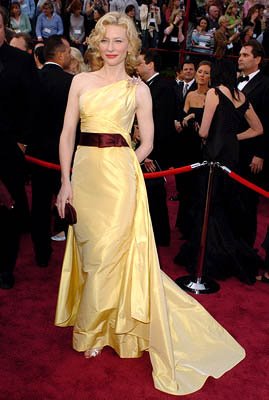
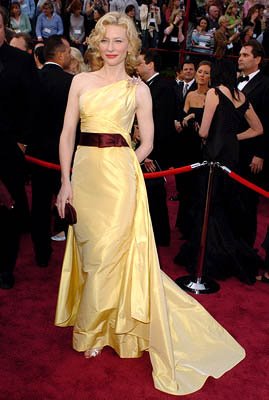
 Kate Blanchett's yellow frock with the wide belt(below): this is about as good as an Oscars dress and an Oscars look can get. Regal. Beautiful.
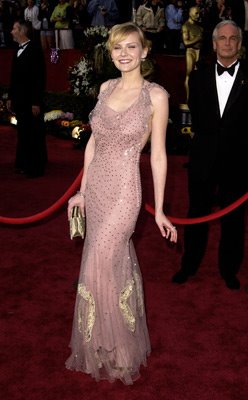
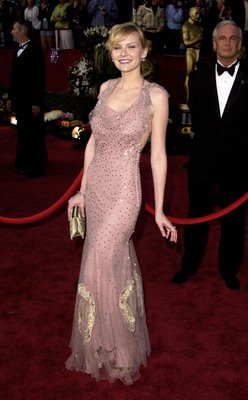
An excellent choice for Kirsten Dunst. She has such a well-scrubbed, All-American look that she can turn up the glamour meter as high as possible, yet never seem overdone. She looks like a silent screen star.
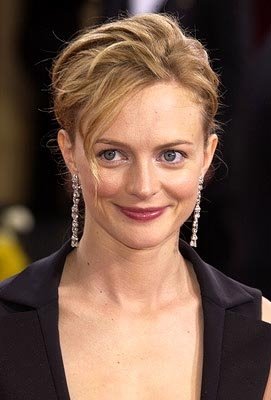 There's something about Heather Graham. She seems accessible. Fun loving. Up for anything. Almost any man would love to romance Rollergirl.
Speaking of, why is the man directly below smiling?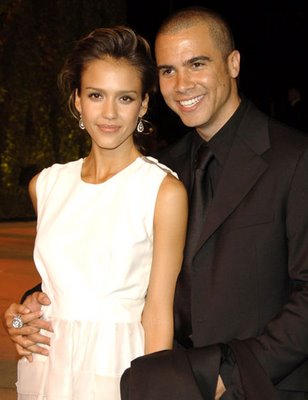
Charlize Theron looks like a Greek goddess. Very, very nice choice. Very, very nice Charlize. Julianne Moore: most everything I said about Kate Winslett, here, applies to Julianne Moore. It's odd that both are English. Or, maybe not. Julianne is talented, and she seems like a completely decent broad. She would wear well over time. You could imagine being with her for the long term. This lustrous green brings out the color in her hair. Striking.

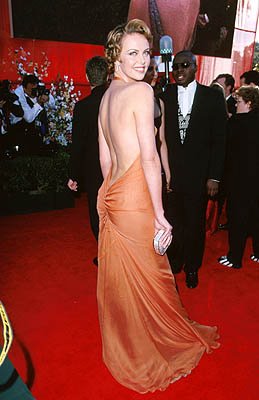
Speaking of Greek, Diane Lane looks like a woman of Sparta: a vision of health and vitality. Her maturity shows through in the openness evident in her eyes; and in her confident, graceful bearing. She is not vamping. She is not coquettish. She squares up and looks straight into the camera - a woman at her best. Her maturity enhances her attractiveness.

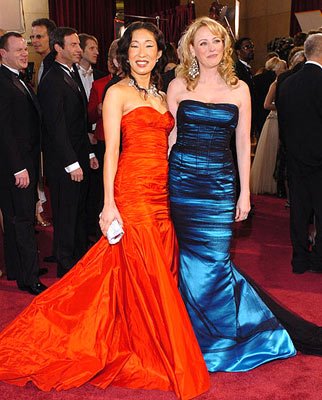
Sandra Oh and Virginia Madsen really get it. They've made selections which are appropriate for the occasion, and they look to be completely enjoying the moment. Salute!
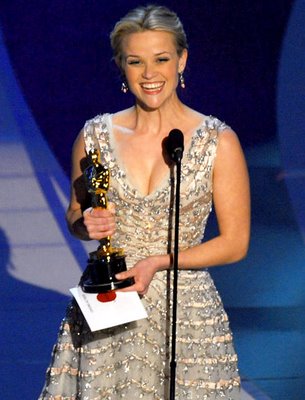
With the choice of this beautiful dress, Reese Witherspoon shows she has excellent taste. It's not a dress a twentysomething would typically choose, yet she carries it off with class. I liked her acceptance speech, also. Very classy.

Salma Hayek makes consistently excellent choices. The darker blue dress (below left) is sort of a "do me, do me" look - but in a good way. The Oscars is the perfect occasion for such a look.
Look at how pretty Scarlett Johansson is! She has classic facial structure, and it will wear well over time. I also included her as an excuse to reprint the photo at bottom(so to speak!).
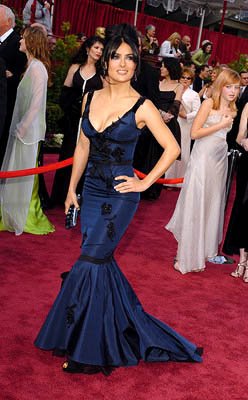

Salma Hayek's pose below is reminiscent of Marilyn Monroe.


On the Vanity Fair cover, Scarlett Johannson looks like a wood-nymph come to life. She also looks like an illustration on a fancy and luxurious box of ladies' bath powder, circa about 1935. It feels as though we could open the top of this picture and pull out an extravagant, powder-dusted puff.
Notice how Keira Knightly looks severe and harsh in comparison? Ms. Knightly is an example of the glamour industry exalting a skinny slip of a girl. If you saw her away from the camera, she would seem stick-like, with pointy edges. I'm sure she's very nice, and very talented. But the severity of her look starkly contrasts with the womanly earthiness, and the desirability, of a Kate Winslett.
 Kate Blanchett's yellow frock with the wide belt(below): this is about as good as an Oscars dress and an Oscars look can get. Regal. Beautiful.
An excellent choice for Kirsten Dunst. She has such a well-scrubbed, All-American look that she can turn up the glamour meter as high as possible, yet never seem overdone. She looks like a silent screen star.
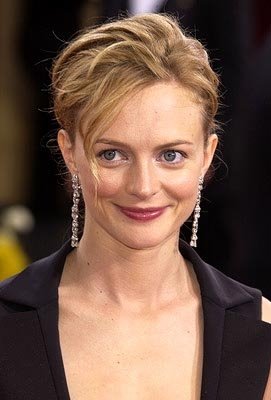 There's something about Heather Graham. She seems accessible. Fun loving. Up for anything. Almost any man would love to romance Rollergirl.
Speaking of, why is the man directly below smiling?
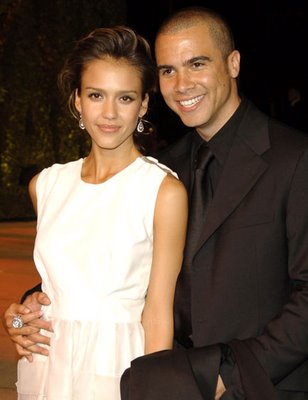
Charlize Theron looks like a Greek goddess. Very, very nice choice. Very, very nice Charlize. Julianne Moore: most everything I said about Kate Winslett, here, applies to Julianne Moore. It's odd that both are English. Or, maybe not. Julianne is talented, and she seems like a completely decent broad. She would wear well over time. You could imagine being with her for the long term. This lustrous green brings out the color in her hair. Striking.


Speaking of Greek, Diane Lane looks like a woman of Sparta: a vision of health and vitality. Her maturity shows through in the openness evident in her eyes; and in her confident, graceful bearing. She is not vamping. She is not coquettish. She squares up and looks straight into the camera - a woman at her best. Her maturity enhances her attractiveness.

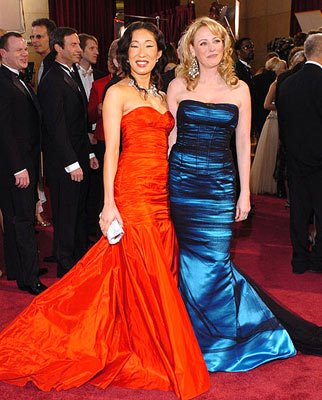
Sandra Oh and Virginia Madsen really get it. They've made selections which are appropriate for the occasion, and they look to be completely enjoying the moment. Salute!
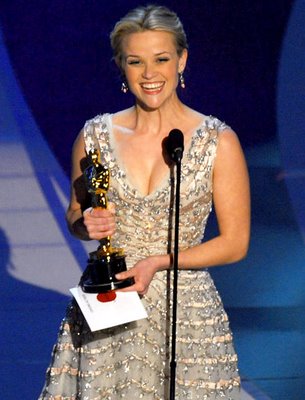
With the choice of this beautiful dress, Reese Witherspoon shows she has excellent taste. It's not a dress a twentysomething would typically choose, yet she carries it off with class. I liked her acceptance speech, also. Very classy.

Salma Hayek makes consistently excellent choices. The darker blue dress (below left) is sort of a "do me, do me" look - but in a good way. The Oscars is the perfect occasion for such a look.
Look at how pretty Scarlett Johansson is! She has classic facial structure, and it will wear well over time. I also included her as an excuse to reprint the photo at bottom(so to speak!).
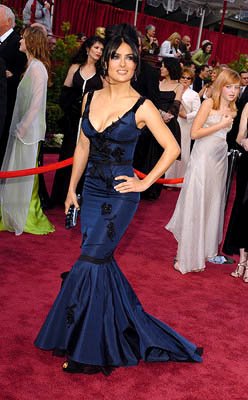

Salma Hayek's pose below is reminiscent of Marilyn Monroe.


On the Vanity Fair cover, Scarlett Johannson looks like a wood-nymph come to life. She also looks like an illustration on a fancy and luxurious box of ladies' bath powder, circa about 1935. It feels as though we could open the top of this picture and pull out an extravagant, powder-dusted puff.
Notice how Keira Knightly looks severe and harsh in comparison? Ms. Knightly is an example of the glamour industry exalting a skinny slip of a girl. If you saw her away from the camera, she would seem stick-like, with pointy edges. I'm sure she's very nice, and very talented. But the severity of her look starkly contrasts with the womanly earthiness, and the desirability, of a Kate Winslett.
Tuesday, March 07, 2006
Oscars "Do's" of Kate Winslett
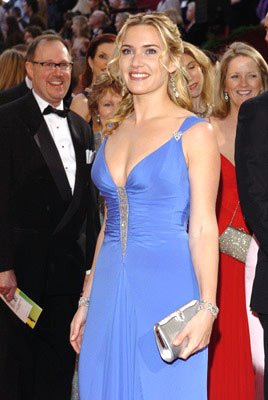
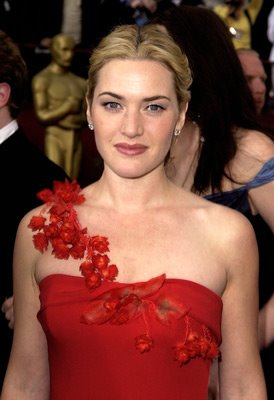
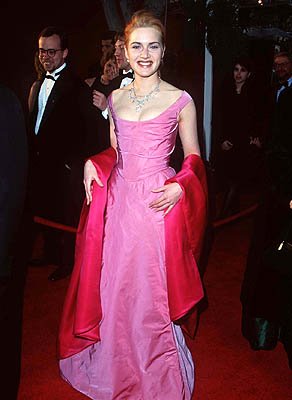
I was at Yahoo's "Oscars Roundup", looking at pictures of "Do's and Don'ts" from past years, and I noticed picture after picture of Kate Winslett, listed under "Do's." I like this young woman very much. Not only is she a kick-ass actress, but she seems personable, down to earth, and smart. Ms. Winslett has the type of classic beauty which endures, and is a throwback to early Hollywood glamour days. Hollywood should be embarrassed for trying to pass off airheaded waifs as actual beauties. I'll point to an example: Gwyneth Paltrow. Gwyneth might be a nice person, but she pales next to Kate Winslett's talent, and next to Kate Winslett's life-force. Imagine what Ms. Winslett could've done with Ms. Paltrow's juicy role in "Shakespeare in Love." Ms. Winslett might've made that movie an all-time classic. She might've made Ms. Paltrow's role an all-time memorable performance. I would like to have seen it.
Try to imagine "Titanic" without Ms. Winslett's energy, and earthiness. Imagine it with, say... Winona Ryder? Or Jennifer Aniston? Booorrriiing. Now imagine "Legends of the Fall" with Ms. Winslett, instead of Julia Ormond. A very nice movie gains some needed spice. Ms. Winslett would've improved it for sure.
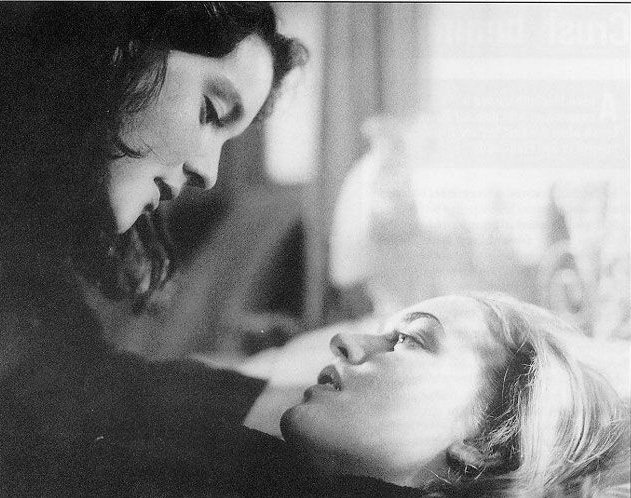
Kate Winslett's first notable role was in "Heavenly Creatures", the true story of teen-aged lesbian lovers who killed one of their Moms in a bid to stay together. Ms. Winslett stole that movie with her ebullience. She instantly became the dream teenaged lover of lesbians around the world. So, she's also got that going for her! Without further ado, the final three Oscars "Do's" of Kate Winslett:

Thursday, February 23, 2006
Islamic Art Images of Prophet Muhammad




Lets put this Prophet Muhammad image thing to bed. Some Muslims obviously do not believe in depicting Muhammad. Other Muslims obviously do believe in depicting Muhammad, as proven by the following links to depictions of the Prophet Muhammad in Muslim art. The question becomes: Do we give up some of our freedom in order to partially (minutely) appease the portion of the Muslim world which wants us dead anyway?
Prophet Muhammad Image Archive.
Prophet Muhammad depicted in Islamic Art.
Prophet Muhammad depicted on murals of modern Iranian buildings.
Hat tip: www.zombietime.com:
This Los Angeles Times article points out that several leading museums in the United States possess Islamic portraits of Mohammed in their permanent collections, though they are rarely displayed. (Hat tip: Killgore Trout.)
This February 14 article in the Washington Post also lists several museums and galleries in the U.S. which own paintings of Mohammed.
Cartoon Jihad and Winston Churchill
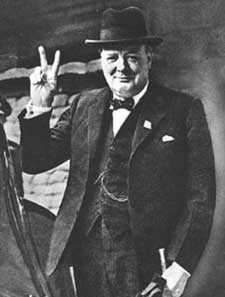
Men occasionally stumble over truth. But most of them pick themselves up and hurry off as if nothing ever happened.
-Winston Churchill
When we were attacked on Sept. 11 ...
[w]hat we never imagined was that the free press ...
would be among the first to surrender.
-Bill Bennett and Alan Dershowitz, writing in WaPo
When the cartoon jihad began, I was mildly interested. As it became obvious the cartoon jihad was an Islamic fundamentalist strategy to maintain control of their base, I became more interested. As people died, and property was destroyed, I became even more interested. As the West reacted with denial, self-doubt, and cowardice, I became keenly interested - to the point of crying out a warning: this is war!
Apparently, it hasn't occurred to the media poo-bahs that the prohibition against likenesses of Mohammed should apply only to Muslims, not to the rest of us. (As Dennis Prager noted, "It's like Jews rioting when someone else eats pork.")
[...]
And that's what makes the press's abject cravenness so consequential. It implies that, for all intents and purposes, we are living under sharia.
-Joel Engel in the Weekly Standard
The cartoon jihad IS the war between Islamic fundamentalism and Western Civilization - it just looks different from our preconceptions of what war is. Wake up, Western Civilization! Wake up! We are in a war for the very existence of our culture! It would be nice if we candidly acknowledged that. And terrible weapons are coming - in the very near future - to an Islamic nation within travelling distance of you. These weapons will roil the very nature of the conflict. It would be nice if we candidly acknowledged that also.
We must think strategically: Islam must reform itself - right now - or else. From Wretchard's brilliant The Three Conjectures, written in Sept. 2003:
However, suppose Pakistan or North Korea engineered a reliable plutonium weapon that could be built to one-point safety in any machine shop with a minimum of skill, giving Islamic terrorists the means to repeatedly attack America indefinitely. Under these circumstances, there would no incentive to retaliate proportionately. The WMD exchange would escalate uncontrollably until Islam was destroyed.
[...]
The so-called strengths of Islamic terrorism: fanatical intent; lack of a centralized leadership; absence of a final authority and cellular structure guarantee uncontrollable escalation once the nuclear threshold is crossed.
[...]
The most startling result of this analysis is that a catastrophic outcome for Islam is guaranteed whether America retaliates or not. Even if the President decided to let all Americans die to expiate their historical guilt, why would Islamic terrorists stop after that?
[...]
It is supremely ironic that the survival of the Islamic world should hinge on an American victory in the War on Terror, the last chance to prevent that terrible day in which all the decisions will have already been made for us. That effort really consists of two separate aspects: a campaign to destroy the locus of militant Islam and prevent their acquisition of WMDs; and an attempt to awaken the world to the urgency of the threat. While American arms have proven irresistible, much of Europe, as well as moderates in the Islamic world, remain blind to the danger and indeed increase it.
Think strategically! If interim Western options such as: economic obstruction, spying, profiling, torture, invasion, spreading democracy, and spreading Western cultural principles, are ineffective; or are unavailable for political reasons; the West will use the only option left to it: nuclear attack. It would be nice if we candidly acknowledged that. Islam, if it emerges from the ruins at all, will emerge in a form which is currently unrecognizable. It would be nice if we candidly acknowledged that.
Western Civilization must generate cultural self-confidence now. The West must stand solidly against the fundamentalists now - when the fundamentalists are weaker than they might become, and when their weaponry includes cartoon jihad, instead of actual WMD. Our culture, and our confidence in it, is the roof which protects us. We must patch the holes in our confidence while the sun yet shines. We must extend the roof eastward while the sun yet shines.
Do not be people without minds of your own,
saying that if others treat you well you will treat them well,
and that if they do wrong you will do wrong.
Rather, accustom yourselves to do good if people do good,
and to not do wrong if they do evil.
-The Prophet Muhammad
(reported by Tirmidhi)
except that this conflict will not be decided by Muslims, but rather by the degree of cultural confidence and moral courage exhibited by the West. Accordingly, there is nothing like Winston Churchill to stiffen spines:
You have enemies? Good. That means you've stood up for something, sometime in your life.
Winston Churchill
One ought never to turn one's back on a threatened danger and try to run away from it. If you do that, you will double the danger. But if you meet it promptly and without flinching, you will reduce the danger by half. Never run away from anything. Never!
Winston Churchill
We shall defend our island, whatever the cost may be, we shall fight on the beaches, we shall fight on the landing grounds, we shall fight in the fields and in the streets, we shall fight in the hills; we shall never surrender.
Winston Churchill
Victory at all costs, victory in spite of all terror, victory however long and hard the road may be; for without victory, there is no survival.
Winston Churchill
Sure I am of this, that you have only to endure to conquer. You have only to persevere to save yourselves.
Winston Churchill
These are not dark days: these are great days - the greatest days our country has ever lived.
Winston Churchill
Wednesday, February 22, 2006
Sarah and Emily Hughes
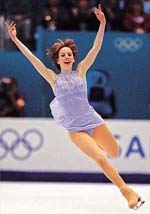

 Look at these pictures, and study Sarah Hughes' and Emily Hughes' faces. Do you see hesitation? Fear? You do not. You see joy in the moment, concentration, self-confidence. You see everything good about sport and humanity. Mr. and Mrs. Hughes must be parenting geniuses. I was moved to tears watching Sarah Hughes' courageous skate in 2002. Sarah rose to the occasion as well as any athlete ever. She hit a jump about one-third of the way into her performance, and she came out of it with the most natural and joyous smile possible. At that moment, Sarah knew, and anyone watching knew, she was about to ace the remainder of her performance. There was no doubt. It would've been the biggest fluke in the world if she had made a mistake after that. The rest of her performance was joyous and breathtaking. It was art. Now comes Emily, with little chance of receiving a medal, yet skating with joy, concentration, and self-confidence. If Mr. and Mrs. Hughes ever write a book, I will be first in line to read it.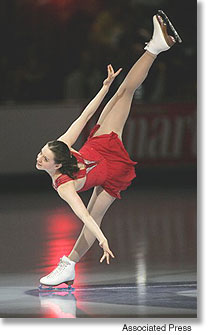
This is what I wrote last night:
It's not that either of the Hughes girls are the best ice-skaters ever, at all.
It is, rather, that they skate into the most intense situations, and deliver performances which are dang near as good as they can possibly do. It is impressive. It is inspiring.
Tuesday, February 21, 2006
Rock Chunkin' Muslim Protesters Throw Like Girls
`
Apparently, Allah never transmitted throwing instructions through the Prophet and to the faithful. Also, no one ever issued a fatwa saying: Keep your elbow up! Gotta be embarrassing for those guys, and maybe it's partly why they're so pissed all the time. I'm just saying. Muslim societies are called "shame societies", and this is obviously something they are ashamed of.
`
Apparently, Allah never transmitted throwing instructions through the Prophet and to the faithful. Also, no one ever issued a fatwa saying: Keep your elbow up! Gotta be embarrassing for those guys, and maybe it's partly why they're so pissed all the time. I'm just saying. Muslim societies are called "shame societies", and this is obviously something they are ashamed of.
`
Thursday, February 16, 2006
Visiting the U.S.S. Lexington
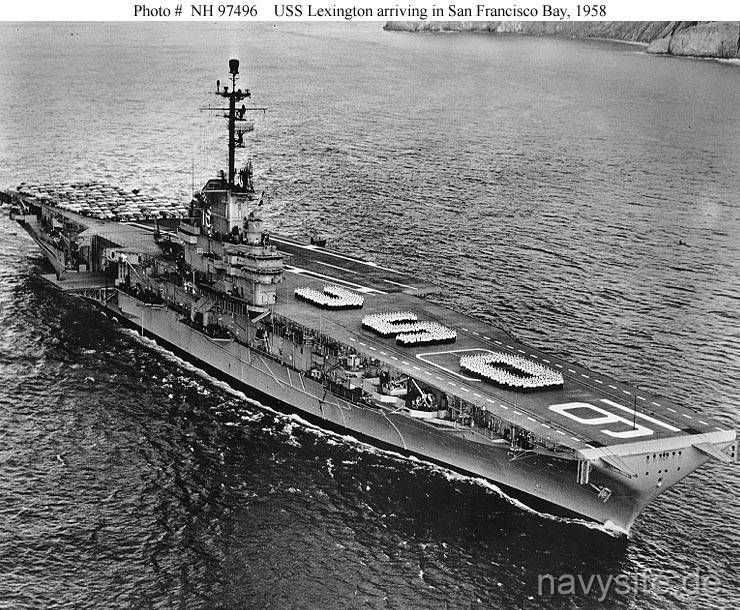
While in Corpus Christi, visited the U.S.S. Lexington! First time I've ever been on a ship longer than about 35'. The Lexington's Flight Deck is 910' long, and 196' at its widest point. (1, 2.
I couldn't help thinking the flight deck - 303 yards x 65 yards at its widest point - would make a nice par 4 of about 290 yards. One would tee an iron from the stern, land in the fattish 50+ yard width beside the conning tower, then bore a knocked down wedge through the wind, and into a green surrounded by water on three sides. I would place the pin about 25' from the back edge. If you put the pin near a corner, only rookies would go for it with a wedge approach. If you elevated the green, and built a St. Andrews' 18th type "Valley of Sin" in front, you'd have a darned challenging hole. Especially if the ocean breeze was blowing into the face of your approach. I believe, seriously, most pros would intentionally land short of the pin, so as not to take any risk of going long. Because the flight deck narrows radically near the bow, I doubt anyone would go for the green from the tee - unless they were trailing by one, and this was the last hole, and the wind was absolutely still. Also, as was the case during my visit, I would place some fighter planes around the flight deck as additional obstacles/decorations. This would be especially good during a tournament, as you could move the planes around from day to day, in conjunction with the pin placement for that day, and also in conjunction with the tee box placement - which could be moved from port to starboard along the stern. I would definitely have the tee shot come out through a tunnel of fighter planes on some days. That would be quite majestic. Imagine a clubhouse and bleachers facing out from an ocean cliff. The golfers could walk down a bridge to play the 18 hole on the aircraft carrier, with fans watching from above. After, golfers could repair to the casinos below decks, and then to their staterooms.
This is the fifth Lexington - so named in 1943 - after the fourth Lexington was sunk in the Battle of the Coral Sea. This fifth Lexington was repeatedly hit by the Japanese during WWII - including a major wounding from a kamikaze plane - yet fought on. Japanese radio reported this Lexington as sunk on four separate occasions, and finally nicknamed her "The Blue Ghost", in honor of her distinctive metallic blue paint, and her seeming resurrection again and again. The metallic blue coloring is very similar to the Dallas Cowboys' football pants' color from the 1970's.
After the aforementioned kamikaze attack, the Lexington lost steering, and circled around the Pacific Ocean both out of control and burning. The Captain broadcast for the crew to go about its duties calmly, and to not worry. The Captain said worrying was his job, and he would do the worrying for all of them. The Lexington eventually guided herself back to Pearl Harbor by steering with her engines: firing on the port side, then the starboard side, to control her direction.
I didn't realize an aircraft carrier rarely, if ever, travelled alone. Aircraft carriers were so valuable that they often went out in the center of armadas, and would be surrounded by circular layers of progressively smaller ships, which formed defensive perimeters to protect aircraft carriers against submarine attack. A sub wanting to get a shot would first have to play like Frogger in the video game, and try to work through the lanes of smaller ships, in order to get to the larger target.
I really dug kicking around below decks, and seeing what an aircraft carrier is all about. I saw this pilot briefing room, complete with comfy chairs for the pilots, who must've been quite pampered, considering it was wartime. Flight was still so romantic during WWII. The military must've wanted the pilots as sharp and as rested as possible for their flights. No tired butts for those boys - only cushy leather chairs would do.
I saw one sign saying the ship carried 1550 crew, and another sign saying the ship carried 3,748 crew, so I don't know the correct figure. The Lexington had barber shop chairs, dental chairs(performed 6,000 dental procedures per year), infirmary, operating rooms(specially designed for quick clean-up during high volume periods), chapel, and a small theater. It had an airplane repair area in midship. And guns everywhere: 12 five-inch guns + 68 40mm guns. It's hard to see how any plane could've gotten through the guns - except in a massive simultaneous attack of numerous planes - which did happen a few times.
As fun, and as interesting, and as big as the Lexington is, I have to admit: I would've felt a bit constricted if I were confined to her on a voyage. I'm a wide open spaces on land guy. On a voyage, once you get the lay of the ship, well, that's all there is. It's a lot: 290 yards x 60 yards x 16 decks high(5 deck Conning Tower + 11 decks below the Flight Deck) - but that is all there is. Once on the ocean, a sailor was stuck. He couldn't go anywhere, except to stroll around the ship. And around, and around, and up and down, and up and down. Sounds odd, but I would've gotten a bit claustrophobic. I think I would've hung around the flight deck in my spare time, just to see some horizon.
All in all, though, an aircraft carrier is mega-cool. U.S.S. Lexington history: 1, 2
Addendum:
Several U.S. cities have turned down memorials to war related heroes or ships, for politically correct reasons of not wanting to promote war. That is a shame - for those cities, and for our nation. Wretchard comments.
I couldn't help thinking the flight deck - 303 yards x 65 yards at its widest point - would make a nice par 4 of about 290 yards. One would tee an iron from the stern, land in the fattish 50+ yard width beside the conning tower, then bore a knocked down wedge through the wind, and into a green surrounded by water on three sides. I would place the pin about 25' from the back edge. If you put the pin near a corner, only rookies would go for it with a wedge approach. If you elevated the green, and built a St. Andrews' 18th type "Valley of Sin" in front, you'd have a darned challenging hole. Especially if the ocean breeze was blowing into the face of your approach. I believe, seriously, most pros would intentionally land short of the pin, so as not to take any risk of going long. Because the flight deck narrows radically near the bow, I doubt anyone would go for the green from the tee - unless they were trailing by one, and this was the last hole, and the wind was absolutely still. Also, as was the case during my visit, I would place some fighter planes around the flight deck as additional obstacles/decorations. This would be especially good during a tournament, as you could move the planes around from day to day, in conjunction with the pin placement for that day, and also in conjunction with the tee box placement - which could be moved from port to starboard along the stern. I would definitely have the tee shot come out through a tunnel of fighter planes on some days. That would be quite majestic. Imagine a clubhouse and bleachers facing out from an ocean cliff. The golfers could walk down a bridge to play the 18 hole on the aircraft carrier, with fans watching from above. After, golfers could repair to the casinos below decks, and then to their staterooms.
This is the fifth Lexington - so named in 1943 - after the fourth Lexington was sunk in the Battle of the Coral Sea. This fifth Lexington was repeatedly hit by the Japanese during WWII - including a major wounding from a kamikaze plane - yet fought on. Japanese radio reported this Lexington as sunk on four separate occasions, and finally nicknamed her "The Blue Ghost", in honor of her distinctive metallic blue paint, and her seeming resurrection again and again. The metallic blue coloring is very similar to the Dallas Cowboys' football pants' color from the 1970's.
After the aforementioned kamikaze attack, the Lexington lost steering, and circled around the Pacific Ocean both out of control and burning. The Captain broadcast for the crew to go about its duties calmly, and to not worry. The Captain said worrying was his job, and he would do the worrying for all of them. The Lexington eventually guided herself back to Pearl Harbor by steering with her engines: firing on the port side, then the starboard side, to control her direction.
I didn't realize an aircraft carrier rarely, if ever, travelled alone. Aircraft carriers were so valuable that they often went out in the center of armadas, and would be surrounded by circular layers of progressively smaller ships, which formed defensive perimeters to protect aircraft carriers against submarine attack. A sub wanting to get a shot would first have to play like Frogger in the video game, and try to work through the lanes of smaller ships, in order to get to the larger target.
I really dug kicking around below decks, and seeing what an aircraft carrier is all about. I saw this pilot briefing room, complete with comfy chairs for the pilots, who must've been quite pampered, considering it was wartime. Flight was still so romantic during WWII. The military must've wanted the pilots as sharp and as rested as possible for their flights. No tired butts for those boys - only cushy leather chairs would do.
I saw one sign saying the ship carried 1550 crew, and another sign saying the ship carried 3,748 crew, so I don't know the correct figure. The Lexington had barber shop chairs, dental chairs(performed 6,000 dental procedures per year), infirmary, operating rooms(specially designed for quick clean-up during high volume periods), chapel, and a small theater. It had an airplane repair area in midship. And guns everywhere: 12 five-inch guns + 68 40mm guns. It's hard to see how any plane could've gotten through the guns - except in a massive simultaneous attack of numerous planes - which did happen a few times.
As fun, and as interesting, and as big as the Lexington is, I have to admit: I would've felt a bit constricted if I were confined to her on a voyage. I'm a wide open spaces on land guy. On a voyage, once you get the lay of the ship, well, that's all there is. It's a lot: 290 yards x 60 yards x 16 decks high(5 deck Conning Tower + 11 decks below the Flight Deck) - but that is all there is. Once on the ocean, a sailor was stuck. He couldn't go anywhere, except to stroll around the ship. And around, and around, and up and down, and up and down. Sounds odd, but I would've gotten a bit claustrophobic. I think I would've hung around the flight deck in my spare time, just to see some horizon.
All in all, though, an aircraft carrier is mega-cool. U.S.S. Lexington history: 1, 2
Addendum:
Several U.S. cities have turned down memorials to war related heroes or ships, for politically correct reasons of not wanting to promote war. That is a shame - for those cities, and for our nation. Wretchard comments.
Wednesday, February 08, 2006
Favorite Quotes + Patton
Alex Rodriguez, hit by a pitch, and accosted by Jason Varitek for yelling at Red Sox pitcher, turns on Varitek:
Alex Rodriguez- "F*** YOU! F*** YOU! F*** YOU!"
Jason Varitek- "F*** YOU! We don't throw at F***ing .275 hitters!"
Allah in the House
Osama and the mujahideen saw a website that claimed Jews are controlling the world with robots. The mujahideen were frightened, and declared jihad on robots: The intifada against Jew robots continues apace this morning, kufr. Three more Zionist vending machines and 11 ATMs have been liquidated by shahids in glorious martyrdom operations.
Charles Krauthammer:
"To understand the workings of American politics, you have to understand this fundamental law: Conservatives think liberals are stupid. Liberals think conservatives are evil."
(Greg's note: except for the liberals who don't believe in the existence of evil...)
Jamie Lee Curtis' exasperated speech to Kevin Kline's Otto, in A Fish Called Wanda:
"Aristotle was not Belgian. The central teaching of Buddhism is not 'Every man for himself.' The London Underground is not a political movement. These are mistakes, Otto. I looked them up."
-Howard Kurtz via Virginia Postrel
"Bush told his senior aides Tuesday that he 'didn't want to see any stories' quoting unnamed administration officials in the media anymore, and that if he did, there would be consequences, said a senior administration official who asked that his name not be used."
via Jay Nordlinger Pine Bluff. Black History Month. Come to school as famous African-American. My co-worker's kid was told to come as Tina Turner. My co-worker informed the teacher that her child would come as Condoleezza Rice instead. The teacher refused to allow it, on grounds that Rice 'is for white people.'
Frederick the Great--
"To defend everything is to defend nothing."
The keynote is delivered by Ann Coulter, in an instant classic published today:
In order to express their displeasure with the idea that Muslims are violent, thousands of Muslims around the world engaged in rioting, arson, mob savagery, flag-burning, murder and mayhem, among other peaceful acts of nonviolence. Muslims are the only people who make feminists seem laid-back.
The little darlings brandish placards with typical Religion of Peace slogans, such as:
"Behead Those Who Insult Islam,"
"Europe, you will pay, extermination is on the way" and
"Butcher those who mock Islam."
They warn Europe of their own impending 9/11 with signs that say:
"Europe: Your 9/11 will come"
— which is ironic, because they almost had me convinced the Jews were behind the 9/11 attack.
Patton Info:
The known copies of Patton's actual speech to the Third Army on June 5, 1944 were destroyed in a fire. Charles M. Province discovered an extra copy which one of Patton's aides had stored away in an attic. Click to read Patton's actual speech, which was delivered without notes. Mr. Province relates that one of Patton's compatriots said the real-life General was much more profane than the Hollywood version. Mr. Province continues:
Alex Rodriguez- "F*** YOU! F*** YOU! F*** YOU!"
Jason Varitek- "F*** YOU! We don't throw at F***ing .275 hitters!"
Allah in the House
Osama and the mujahideen saw a website that claimed Jews are controlling the world with robots. The mujahideen were frightened, and declared jihad on robots: The intifada against Jew robots continues apace this morning, kufr. Three more Zionist vending machines and 11 ATMs have been liquidated by shahids in glorious martyrdom operations.
Charles Krauthammer:
"To understand the workings of American politics, you have to understand this fundamental law: Conservatives think liberals are stupid. Liberals think conservatives are evil."
(Greg's note: except for the liberals who don't believe in the existence of evil...)
Jamie Lee Curtis' exasperated speech to Kevin Kline's Otto, in A Fish Called Wanda:
"Aristotle was not Belgian. The central teaching of Buddhism is not 'Every man for himself.' The London Underground is not a political movement. These are mistakes, Otto. I looked them up."
-Howard Kurtz via Virginia Postrel
"Bush told his senior aides Tuesday that he 'didn't want to see any stories' quoting unnamed administration officials in the media anymore, and that if he did, there would be consequences, said a senior administration official who asked that his name not be used."
via Jay Nordlinger Pine Bluff. Black History Month. Come to school as famous African-American. My co-worker's kid was told to come as Tina Turner. My co-worker informed the teacher that her child would come as Condoleezza Rice instead. The teacher refused to allow it, on grounds that Rice 'is for white people.'
Frederick the Great--
"To defend everything is to defend nothing."
The keynote is delivered by Ann Coulter, in an instant classic published today:
In order to express their displeasure with the idea that Muslims are violent, thousands of Muslims around the world engaged in rioting, arson, mob savagery, flag-burning, murder and mayhem, among other peaceful acts of nonviolence. Muslims are the only people who make feminists seem laid-back.
The little darlings brandish placards with typical Religion of Peace slogans, such as:
"Behead Those Who Insult Islam,"
"Europe, you will pay, extermination is on the way" and
"Butcher those who mock Islam."
They warn Europe of their own impending 9/11 with signs that say:
"Europe: Your 9/11 will come"
— which is ironic, because they almost had me convinced the Jews were behind the 9/11 attack.
Patton Info:
The known copies of Patton's actual speech to the Third Army on June 5, 1944 were destroyed in a fire. Charles M. Province discovered an extra copy which one of Patton's aides had stored away in an attic. Click to read Patton's actual speech, which was delivered without notes. Mr. Province relates that one of Patton's compatriots said the real-life General was much more profane than the Hollywood version. Mr. Province continues:
He could, when necessary, open up with both barrels and let forth such blue-flamed phrases that they seemed almost eloquent in their delivery. When asked by his nephew about his profanity, Patton remarked,
"When I want my men to remember something important, to really make it stick, I give it to them double dirty. It may not sound nice to some bunch of little old ladies at an afternoon tea party, but it helps my soldiers to remember. You can't run an army without profanity; and it has to be eloquent profanity. An army without profanity couldn't fight it's way out of a piss-soaked paper bag."
"As for the types of comments I make", he continued with a wry smile, "Sometimes I just, By God, get carried away with my own eloquence."
Subscribe to:
Posts (Atom)


 Posts
Posts